A Brief History of the Permanent Diaconate
by Catherine Horgan
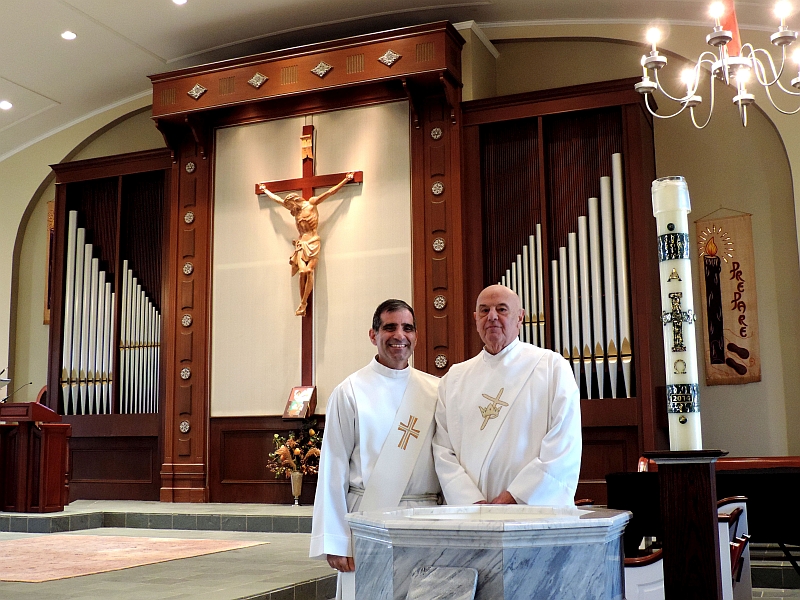 Deacons Mike Gomes & Wayne Padula
(Image courtesy of Lisa Gomes)
At that time, as the number of disciples continued to grow, the Hellenists complained against the Hebrews because their widows were being neglected in the daily distribution. So the Twelve called together the community of disciples and said, 'it is not right for us to neglect the Word of God to serve at table. Brothers, select from among you seven reputable men, filled with the Spirit and wisdom, whom we shall appoint to this task, whereas we shall devote ourselves to prayer and to the ministry of the word.' The proposal was acceptable to the whole community, so they chose Stephen, a man filled with faith and the Holy Spirit, also Philip, Prochorus, Nicanor, Timon,Parmenas and Nicholas of Antioch, a convert to Judaism. (Acts 6:1-5)
No doubt we’re all familiar with this particular passage from Sacred Scripture, but how many of us have ever realized that it actually describes the first selection of men to whom we now refer as Permanent Deacons? In fact, when a man is ordained to the diaconate, the bishop is likely to pray, “Like the men the apostles chose for works of charity, you should be men of good reputation filled with wisdom and the Holy Spirit.”
Among those first seven men who were called to serve was St. Stephen the Martyr, whose feast we celebrate on December 26. It’s not surprising then is it, that St. Stephen is the Patron Saint of Deacons.
So what’s the significance of the Office of Permanent Diaconate in the modern church? It’s a centuries-old ministry that was abandoned by the early church around the fourth century, but was revived as a result of the Second Vatican Council, which decreed that it be opened to “mature married men”, which was later clarified to mean men over the age of 35.
While the early members of the diaconate (from the Greek diakonos, “servant”) were primarily concerned with ensuring the general well being of the widowed and orphaned among them, modern day deacons can be found carrying out their ministerial responsibilities in parishes, hospitals and prisons, tending to the abused and battered, the mentally ill, the homeless and victims of discrimination. They are in large cities, small towns and rural communities, holding the hands of the sick and the dying, bringing the light of Christ into the darkest corners of our world.
In a parish setting, a deacon’s general role is to assist the pastor in carrying out his pastoral responsibilities. As an ordained cleric, a deacon can preside at the sacrament of baptism; proclaim the Gospel and preach; preside at funerals, graveside services, and wake services; witness marriages, and of course, distribute Holy Eucharist. He cannot preside at mass which, of course, would include praying over the gifts of bread and wine that they may become the Body and Blood of the Lord, a privilege reserved for those ordained as priests. Nor can a deacon preside in celebrations of the sacrament of penance or anointing of the sick.
With over 18,000 ordained deacons in the United States alone, these men, along with their wives and families, continue to serve the people of God. Here at the Parish of St. James, we are most fortunate to have with us, Deacon Wayne T. Padula and Deacon Michael Gomes. As parishioners, we have all experienced the unique gifts each man brings to his ministry and we are grateful that they heeded God’s call to this vocation.
Sources: USCCB, FAQ’s About Deacons; Diocese of Manchester, NH, Who is a Permanent Deacon and What Does He Do?; Canon Law Made Easy – Church Law for Normal People; and The Pontifical North American College – What is a Deacon?